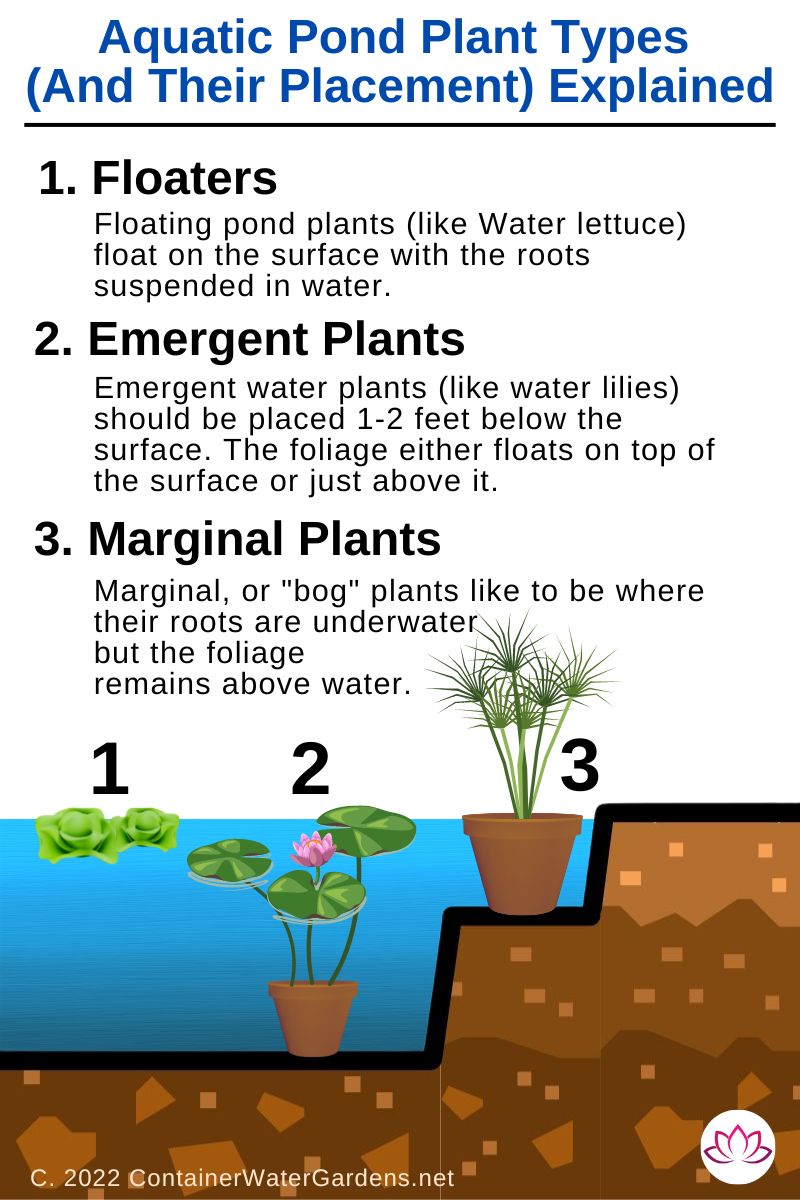
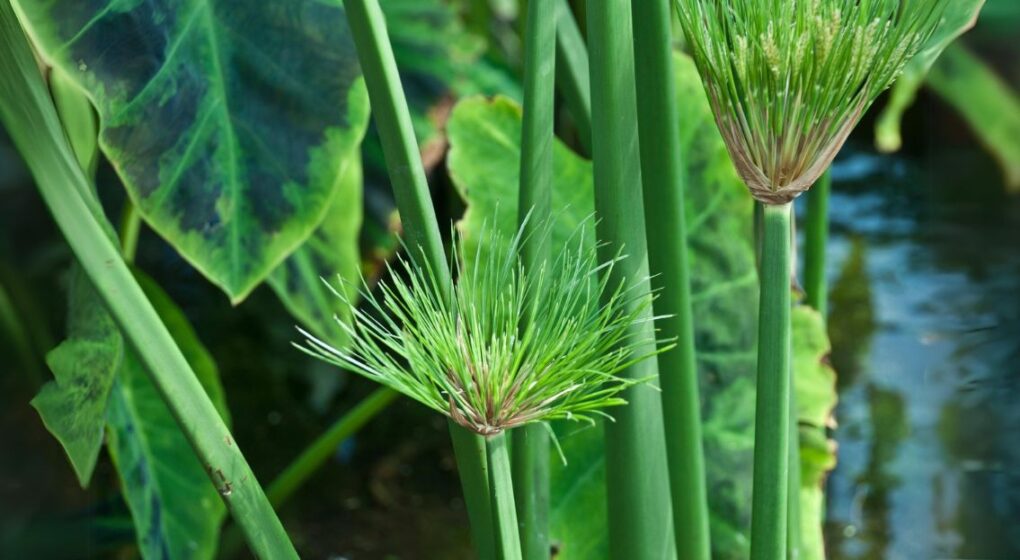
Think about your pond or container water feature the way you’d think about a garden bed: design with texture and foliage color first, and treat the flowers as the bonus they are. A pond with the right mix of spiky, broad, feathery, and trailing foliage plants looks intentional even when nothing is blooming.
Below, we’ll walk through four foliage textures every well designed pond needs, with plant picks for each plus notes on which ones hold their color into fall and which ones need a little more seasonal planning.
📌 A Note on Container-Growing “Aggressive” Pond Plants
Several plants on this list (horsetail, parrot’s feather, dwarf cattail, and variegated Houttuynia) are stunning for texture and color, but they spread aggressively by rhizome or fragments. Some are classified as invasive in parts of the U.S. and parrot’s feather is banned outright in the U.K.
That doesn’t mean skip them. It means always growing them in a submerged container, never free-planted directly into pond mud or natural margins. Take a minute to check your state or region’s invasive pond plant species list before buying. Where a plant should only be grown in container ponds (like half whiskey barrels, stock tanks, and glazed ceramic containers), you’ll see a ⚠️ next to it.
1. Spiky & Upright — Vertical Structure
Every pond needs at least one upright element. Without it, a planting scheme reads as flat — just a collection of things floating or mounding at water level with nothing to break up the horizontal plane. Spiky, vertical foliage is what gives a pond a skyline.
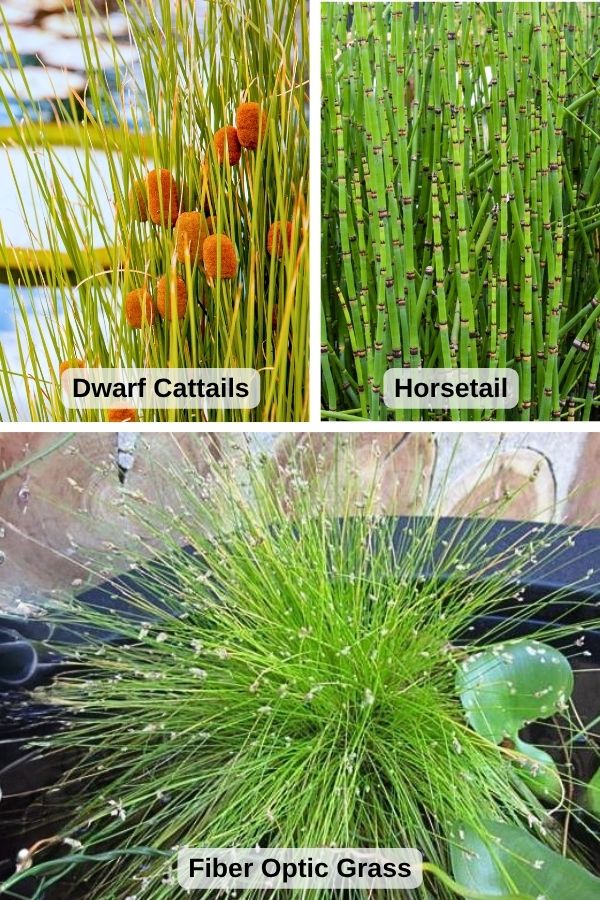
Dwarf Cattail (Typha minima) ⚠️
Narrow, blue-green needle-like foliage growing 18–24″ tall — a true dwarf version of the cattail you’re picturing, scaled down for small ponds and containers. Small brown catkins appear mid-to-late summer. Hardy in zones 3–10 and dies back to the waterline each winter, returning reliably in spring. Container only — see note above.
Fiber Optic Grass (Isolepis cernua)
Fine, hair-like bright green foliage tipped with tiny white or cream flowers, giving it a look somewhere between a grass and a fireworks burst. It mounds upright as a young plant, then gracefully arches as it matures — a nice textural bridge between the rigid verticals and your feathery plants.
Hardy in zones 8–11; grown as an annual or overwintered indoors elsewhere. Keep the crown at the waterline with no more than 2″ of water over the soil. Foliage yellows as fall temperatures drop; cut back hard in spring for fresh growth.
Horsetail (Equisetum hyemale) ⚠️
Rigid, jointed, bamboo-like stems that read as almost architectural — a favorite for modern-style ponds. Evergreen in mild climates, hardy in zones 4–12. Container only — see note above, as this one spreads by tough rhizomes that are genuinely difficult to remove once established in pond mud.
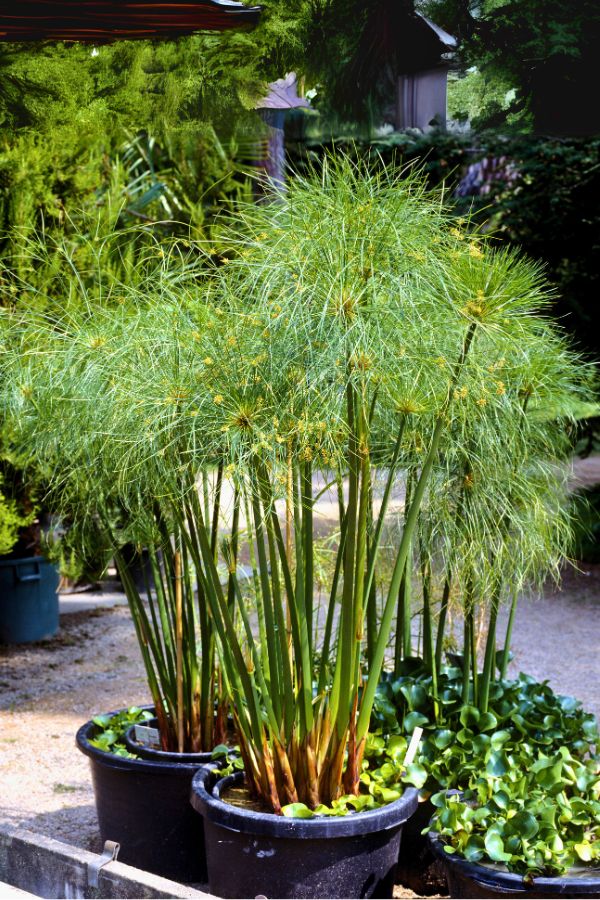
Dwarf Papyrus (Cyperus haspan or Cyperus involucratus ‘Nanus’)
Grassy leaves radiate from the stem tip in an umbrella or firework shape, growing 1.5–2.5 feet tall. Hardy in zones 8–10; elsewhere, treat as a seasonal annual or bring indoors before frost. A softer, more tropical-looking alternative if you want height without the rigidity of horsetail.
Seasonal takeaway: dwarf cattail and horsetail carry structure through winter (horsetail evergreen, cattail returning reliably each spring), while fiber optic grass and dwarf papyrus are better treated as warm-season stars in colder zones.
2. Broad-Leaf — Bold Contrast
If spiky foliage gives your pond a skyline, broad leaves give it weight and shade. Large leaves anchor a planting scheme, offer shelter for fish, and create the kind of contrast that makes fine-textured neighbors look even finer by comparison.
Standard And Dwarf Canna (Canna/Canna hybrids)
Dwarf canna lilies are compact, tropical perennials that deliver the same bold foliage and vibrant flowers as the standard sized cannas, but mature at a manageable height of 1.5 to 3 feet making them a better choice for container ponds.
Hardy Water Canna (Thalia dealbata)
Blue-green, powdery-coated leaves shaped like a canna lily’s, topped with tall purple flower spikes in summer. One of the most reliably cold-hardy “big leaf” options on this list — hardy in zones 6–10, so it can stay in the ground through winter in much of the country. A great starting point if you want bold foliage without babying a tropical plant.
Red-Stemmed Thalia (Thalia geniculata ‘Ruminoides’)
The showier, more tropical-looking cousin of hardy water canna: bright red stems support lime-green, paddle-shaped leaves up to 24″ long. The red-on-green contrast alone earns this plant a spot on a texture-and-color-focused list. It’s less cold-hardy than T. dealbata, though — hardy in zones 8–10, so gardeners in cooler zones should plan to treat it as an annual or overwinter the roots indoors. Plant in water up to 10″ over the crown.
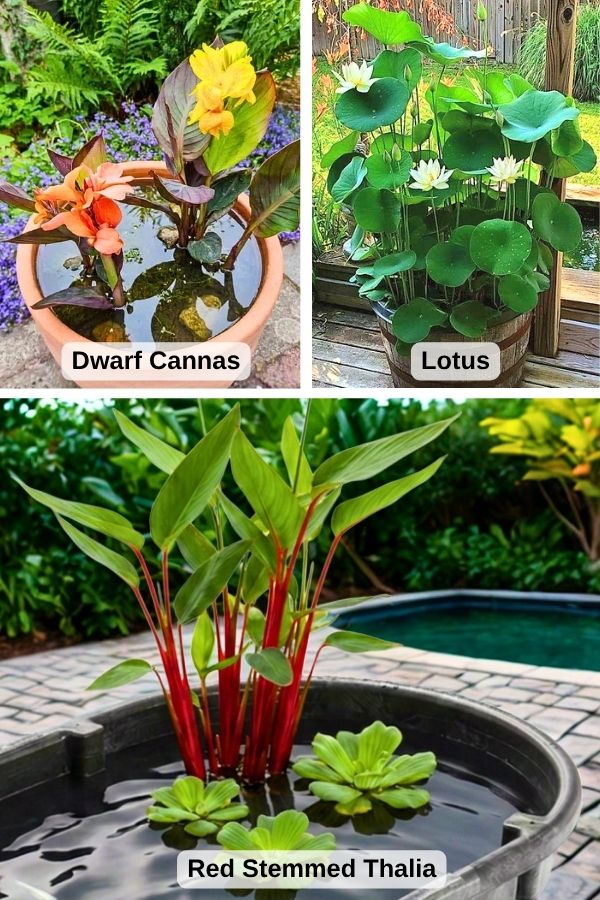
Lotus
Large, rounded, blue-green leaves held well above the water on tall stems, plus the added bonus of dramatic summer blooms. Hardy varieties are surprisingly cold-tolerant for how tropical they look — zones 4/5–10 depending on cultivar — and dwarf types make it possible to grow lotus even in a half-barrel or patio container.
One thing worth telling beginners upfront: lotus dies back completely in winter and is slow to re-emerge in spring, so don’t panic if your pot looks empty until the water warms past 70°F.
Seasonal takeaway: hardy water canna and lotus are the two you can count on returning year after year in most zones; dwarf Cannas and red-stemmed Thalia deliver the boldest color of the three but asks for a little more winter planning in anything colder than zone 8.
3. Feathery & Fine-Textured — Softness
Fine-textured foliage is the detail work — it softens hard edges, adds movement, and makes the bold, broad leaves nearby look even bolder by contrast. This is the category that keeps a pond from feeling like a series of solid shapes stacked next to each other.
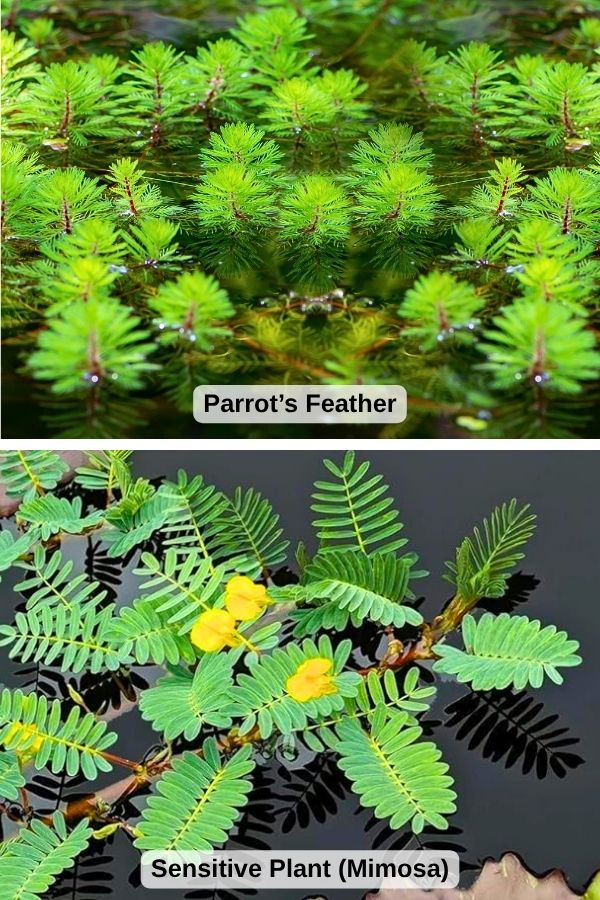
Parrot’s Feather (Myriophyllum aquaticum) ⚠️
Finely divided, blue-green feathery foliage that grows both submerged and emergent — underwater stems stay soft and limp, while stems that reach the surface stiffen and take on a slightly deeper blue-green hue, almost like tiny fir branches dotting the water’s surface.
It’s genuinely one of the softest, most delicate-looking textures you can add to a pond. That said, it’s classified as invasive throughout much of the U.S. and banned outright in the UK, and it spreads readily from broken stem fragments. Container only — see note above, and trim it back every month or two so it doesn’t overtake the rest of the planting.
Sensitive Plant (Neptunia aquatica) ⚠️
Also called Water Mimosa, this aquatic plant features fern-like green leaves that fold inward within seconds of being touched or disturbed.Throughout the summer months, It produces distinctive, small, yellow flowers densely crowded into feathery, ball-like inflorescences.
While it only grows 3 to 6 inches tall, its creeping stems can spread 3 to 5 feet in length by the end of a single season. For this reason, it’s best kept in a container where it can be controlled and easily trimmed when necessary.
Dwarf Umbrella Plant / Fine Cyperus (Cyperus involucratus ‘Nanus’ or similar compact sedges)
Slender, grass-like stems topped with a whorl of fine, radiating bracts — a smaller-scale, softer-textured relative of full-size umbrella palm. Works well tucked between broad-leaf plants and pond edges to keep the transition from feeling abrupt.
Hardy in zones 8–10 as a perennial; treated as an annual or overwintered indoors in cooler areas. Best kept in containers, as some cyperus species self-seed and spread readily in warm, wet conditions.
Seasonal takeaway: none of these three are reliably cold-hardy outside zones 8–10 — in colder zones, treat feathery texture as a warm-season addition, and either overwinter containers indoors or plan to replace them each spring.
4. Trailing & Mounding — Edges and Overflow
This is the category that softens the hard line between pond and landscape. Trailing and mounding plants spill over rocks, cascade down container rims, and make the transition from water to garden bed look natural instead of abrupt.
Variegated Houttuynia (Houttuynia cordata ‘Chameleon’) ⚠️
Without question the most colorful foliage on this entire list — heart-shaped leaves splashed with red, pink, yellow, and cream, held on red stems. If you want a single plant that does the most work for “foliage color” in this post’s title, this is it.
It’s also very cold-hardy, holding up in zones 4–10. The catch: it’s aggressively invasive by rhizome and is banned or discouraged in some regions, so this is the one plant on the list where the container-only rule really isn’t optional. Container only — see note above — and it’s worth double-checking your local invasive species list before buying, since restrictions vary by state.
Creeping Jenny / Moneywort (Lysimachia nummularia ‘Aurea’) ⚠️
Rounded, chartreuse-to-golden-yellow leaves on trailing stems that form a dense, cascading mat — ideal for spilling over pond edges or rockwork. Color intensity depends on sun: full sun brings out a true gold, while shade shifts the foliage toward green.
Hardy in zones 3–9. It’s considered moderately invasive in parts of the U.S. where it’s naturalized along waterways, so the same container guidance applies here, though it’s a less aggressive spreader than Houttuynia or parrot’s feather.
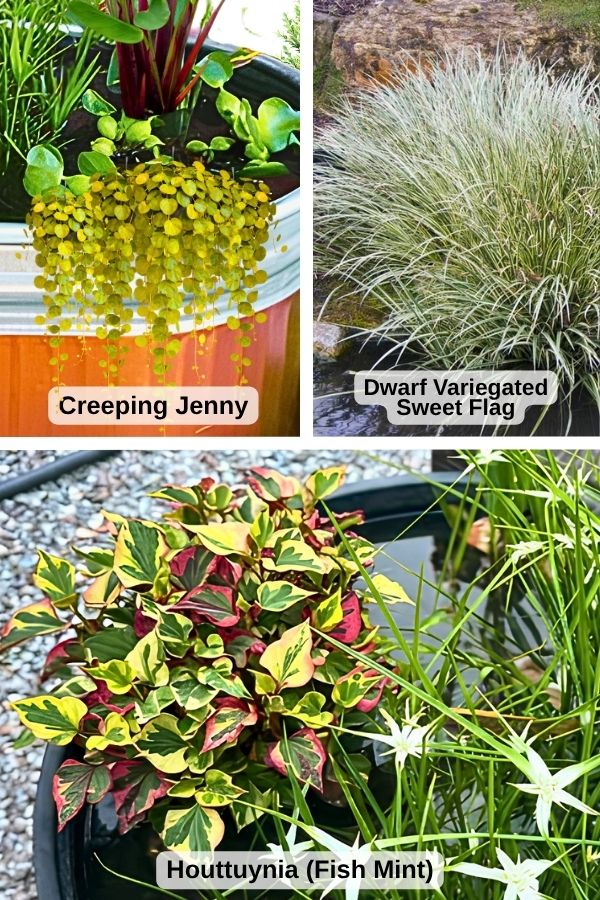
Dwarf Variegated Sweet Flag (Acorus gramineus ‘Variegatus’)
A nice palate-cleanser after two cautionary entries — this one isn’t considered invasive. Grass-like green-and-white striped foliage (or green-and-gold for the ‘Ogon’ variety) forms neat, low mounds 8–12″ tall. Hardy in zones 5/6–11, and it holds its variegated color right through winter in zone 6 and warmer, making it one of the few plants on this whole list that offers genuine four-season interest without dying back. A great “safe” pick for readers who want trailing texture without another invasive-species caveat to manage.
Seasonal takeaway: dwarf variegated sweet flag is your year-round color anchor at the pond’s edge; Houttuynia and creeping jenny bring the boldest color payoff in the growing season but need containment and a little more year-round attention.
5. Putting It Together: A Sample Layered Planting
Reading about texture in isolation is one thing — seeing how it comes together in an actual pond is another. Here’s a sample planting that pulls one plant from each category to show how the layering works in practice:
- Vertical anchor: Horsetail, container-grown at the back or center of the planting for a strong architectural line
- Bold contrast: Hardy water canna, placed where its blue-green paddle leaves can catch the light next to the horsetail’s rigid stems
- Soft texture: Parrot’s feather, tucked in front of the water canna so its feathery growth softens the transition between the two bolder plants
- Trailing edge: Dwarf variegated sweet flag along the pond’s rim, spilling gently over the edge and tying the whole planting back down to the waterline
Notice what’s happening here: every plant is doing a different visual job. Nothing is competing for the same role, which is exactly what keeps a foliage-first planting from looking busy or repetitive.
Scaling this down for containers: If you’re working with a half-barrel or container water garden rather than an in-ground pond, the same four-role formula still applies — you’re just working with dwarf or compact versions of each. Swap the horsetail for fiber optic grass, the water canna for a dwarf lotus, and keep the sweet flag and a trimmed piece of parrot’s feather as your soft and trailing elements. The formula scales; only the plant sizes change.